
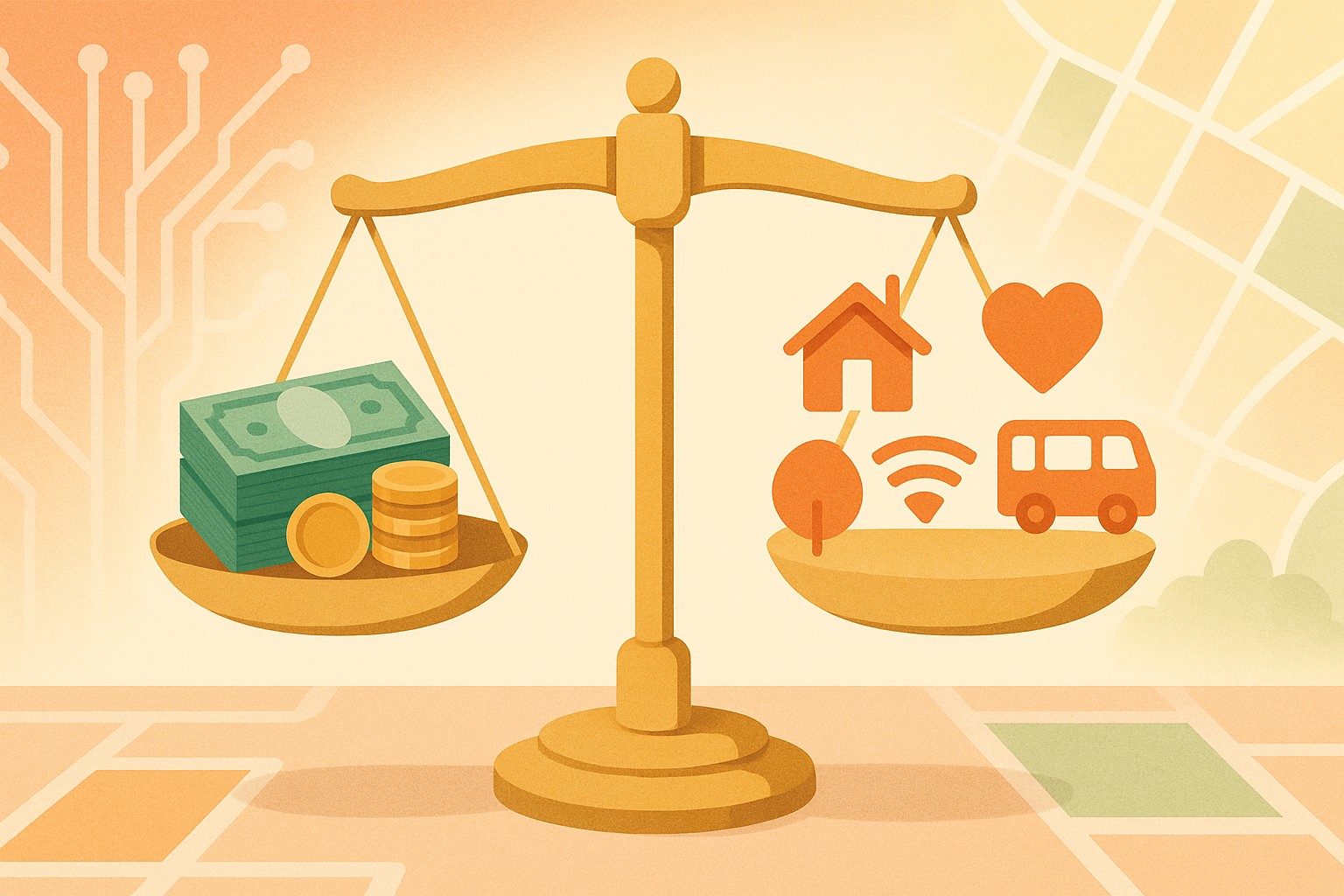
I love the spirit of Universal Basic Income (UBI): a simple, unconditional floor so we can build higher things without constant fear. But when I think about the actual humans I know (my household included), and about the weird incentives of late‑capitalism markets, I keep arriving at a different starting point for the AI era: Universal Basic Services (UBS) as the default, with a modest unconditional stipend on top. Cash is freedom; services are stability. We’ll need both—but services should carry the weight of the floor.
TL;DR
-
Thesis: In an AI‑rich economy, guaranteeing services people must consume to live (housing baseline, healthcare, energy, food staples, broadband, mobility, education/childcare, water/sanitation, and—yes—secure digital identity and compute access) is more resilient and less gameable than cash alone.
-
Hybrid model: UBS + a modest Dignity Stipend preserves autonomy and avoids paternalism while dampening rent extraction and inflationary pressure.
-
How to do it: Make the floor universal, portable, privacy‑preserving, and delivered through competitive provider marketplaces governed by open standards. Fund it with AI dividends (compute/model windfall and data‑value taxes), land/spectrum rents, and carbon externalities, all while measuring success by time abundance, child thriving, and health/learning outcomes.
UBI vs. UBS vs. Hybrid: What Actually Solves the Problem We Have?
| Dimension | UBI (Cash Only) | UBS (Services First) | Hybrid (UBS + Dignity Stipend) |
|---|---|---|---|
| Core promise | Freedom via unconditional money | Stability via guaranteed essentials | Both freedom and stability |
| Inflation & rent capture risk | High (landlords & gatekeepers raise prices) | Lower (public options set reference prices) | Managed (services anchor cost; stipend gives flexibility) |
| Dignity & agency | Strong in theory; can be undercut by rising costs | Risk of paternalism if choice is limited | Strong if services are portable and multiple providers compete |
| Administrative complexity | Simple disbursement | Complex but scalable with modern infra | Medium (services infra + simple stipend) |
| Political durability | Vulnerable to “handout” politics | Durable when tied to universal use (schools, clinics, transit) | Most durable: everyone uses, everyone chooses |
A cash‑only approach assumes the market can efficiently deliver every essential. That’s often untrue where supply is inelastic (housing), asymmetric (healthcare), or natural‑monopoly‑ish (broadband, water, energy). UBS flips the bet: fix the pipes first.
Why Services as the First Layer?
-
Human nature is human reality. Money evaporates under stress. Services calm the chaos. A guaranteed baseline of the things families must buy—rent, food, care, connectivity—removes the “monthly cliff.” As a dad who has watched robotics‑club fees, lunch accounts, and surprise dental bills collide in one week, I don’t want my kids’ wellbeing indexed to whether this month’s budget held.
-
Markets need reference prices. Public options (not public monopolies) create real competition and deflate rents. A well‑run service floor becomes the “good enough” benchmark that disciplines private offerings.
-
AI makes service delivery cheaper. If AI slashes admin, logistics, and forecasting costs, the most responsible place to deploy those gains is where the risk of exploitation is highest: essentials.
What Belongs in “Basic Services” for an AI Economy?
-
Healthcare & mental health (primary + catastrophic coverage).
-
Housing floor (safe, modest, energy‑efficient units; rent‑to‑own pathways).
-
Food staples (nutritious defaults via EBT‑style rails, not restrictions).
-
Energy & water (lifeline kWh & cubic meters; tiered beyond the floor).
-
Broadband & devices (universal high‑speed access + a capable device every N years).
-
Mobility (reliable public transit + micromobility credits).
-
Education & childcare (from early years through lifelong upskilling).
-
Digital identity & privacy‑preserving credentials (the passport for access).
-
Compute as a utility (baseline cloud/AI credits so everyone can build, learn, and create).
Principle: It’s a floor, not a cage. Past the floor, markets, co‑ops, and nonprofits compete on experience and features.
Guardrails Against Paternalism (and Bureaucratic Overreach)
Design goals:
-
Choice & pluralism: Multiple accredited providers per service. Public options exist but don’t crowd out others.
-
Portability: A family moves cities; their services move with them—no re‑qualifying purgatory.
-
Privacy by default: Eligibility proofs via zero‑knowledge credentials; no mass data honeypots.
-
Open standards: City/State “Service SDKs” publish APIs so startups and nonprofits plug in safely.
-
Outcome‑based funding: Pay for reliability and outcomes, not bureaucracy and forms.
-
Local governance with federal floors: Subsidiarity keeps services culturally sane while preventing postcode lotteries.
The Dignity Stipend (Because Freedom Matters)
Even with stellar services, some cash must be unconditional. A monthly stipend—small relative to full UBI—restores agency for the unpredictable and the personal: gifts, hobbies, date nights, a new guitar pick for a future worship‑band hero. This prevents services from turning into a gray wallpaper life.
How Do We Pay for It Without Tanking the Real Economy?
Think rents, not income. Think automation surplus, not payroll.
-
AI Dividends
-
Compute & model windfall taxes when scale yields super‑normal profits.
-
Data‑value returns via civic data trusts (if your community’s data trains models, community shares the upside).
-
-
Classical Rents
-
Land value taxation (capture unearned location gains).
-
Spectrum/orbital slot auctions (and ongoing rents).
-
Carbon & externality pricing (pollution shouldn’t be free).
-
-
Efficiency Dividends
-
Every bureaucratic hour AI kills is money that goes to the floor, not forms.
-
Funding should be counter‑cyclical: when AI profits swell, the service floor fortifies; when profits compress, automatic stabilizers kick in without political theater.
A Practical Rollout Path (Three Concrete Pilots)
-
Connectivity First: Universal 100/20 Mbps and a decent device. It unlocks education, telehealth, job‑search, and community.
-
Care Stack: Expand primary care & mental health access + childcare slots; measure reduced ER loads and improved school attendance.
-
Mobility Credits: Partner transit + micromobility providers; pay for reliability and coverage, not just ridership.
Stand up a City Service Commons with:
-
A digital wallet for credentials and service credits (non‑transferable),
-
Open procurement so startups/co‑ops can bid,
-
Public dashboards tracking uptime, time‑to‑service, and citizen satisfaction.
Risks, Named and Managed
-
Paternalism: Mitigated by real choice, appeal rights, and cash stipend.
-
Bureaucratic creep: Sunset clauses, independent audits, and outcome‑based contracts.
-
Migration magnets & local overload: Federal floors + per‑capita, mobile funding follow the person.
-
Black‑market arbitrage of credits: Use non‑transferable credentials and randomized audits; keep the cash stipend to reduce pressure to game the system.
-
Privacy breaches: Minimize data retention; use verifiable credentials and privacy‑preserving analytics.
Metrics That Actually Matter (A Post‑GDP Scoreboard)
-
Time Abundance Index: Hours per week free from economic compulsion.
-
Child Thriving Index: Attendance, nutrition, safety, and enrichment participation.
-
Healthspan Delta: Preventive‑care adherence and avoidable ER visits.
-
Service Reliability: 99.9% uptime for water, energy, broadband, and transit routes.
-
Learning Velocity: Skill acquisition measured by project portfolios, not just seat time.
-
Carbon Intensity Per Capita: Essentials delivered cleaner each year.
A Faith‑Tinged Note on Floors and Freedom
Ancient Israel’s gleaning laws and the Jubilee were not sentimental add‑ons; they were structural resets so families weren’t trapped forever by one bad season. In an age when algorithms can conjure abundance faster than any harvest, our test is simple: Do people get to rest? Does technology feel like Sabbath—rest that enables creativity and community—or like a treadmill that just got a better motor?
As a husband and father who loves sci‑fi, theology, and a perfectly timed joke, I don’t want a world where my kids inherit “subscription survival.” I want them to inherit guaranteed basics, generous possibilities, and room to try wild things. That’s UBS + a dignity stipend: a floor strong enough to climb from, and wide enough for everyone to stand on together.
Implementation Cheat‑Sheet (If You’re a Mayor, Gov CIO, or Philanthropist)
-
Start with broadband, care, and transit.
-
Issue digital wallets with verifiable credentials.
-
Publish the Service SDK and open data (privacy‑safe).
-
Pay providers on reliability + outcomes.
-
Fund with AI dividends + rents.
-
Track the scoreboard above and publish quarterly.
-
Invite the community to co‑design. Floors are for families, not frameworks.
Final Thought
UBI asks, “What if we gave everyone money?” UBS asks, “What if we made the stuff of life reliable, affordable, and dignified—and then added money for freedom?” In the AI era, that second question is the one that gets us a civilization worth automating.
Comments powered by CComment