
The Last Unfair Advantage: Enterprise Intelligence in an Age When Every Tool Is Equal
When artificial intelligence hands your competitor the same superpowers it handed you, the only thing left is what you actually know. And most organizations have no idea what that is.

Sometime in the next few years, the AI your company uses will be roughly as good as the AI your fiercest competitor uses. Same models, same token limits, same multimodal tricks. The democratization of intelligence tools is not a metaphor. It is a deadline. And most organizations are going to miss it.
There is a scene in the book of Proverbs that almost nobody frames as a business strategy treatise, but maybe they should. "By wisdom a house is built, and through understanding it is established; through knowledge its rooms are filled with rare and beautiful treasures" (Proverbs 24:3-4). The ancient observation is this: the house is not the treasure. What fills it is. The structure you build, no matter how impressive its facade, derives its worth from what is stored inside. Your enterprise is a house. And inside are treasures most of your leadership team could not locate on a map.
This article is about those treasures. About why they are vanishing faster than anyone admits. And about the narrow window still remaining to capture them before the competitive landscape shifts so completely that the only thing distinguishing one AI-enabled enterprise from another is the depth and quality of the intelligence each one has learned to claim as its own.
The Great Equalization Is Not Coming. It Already Arrived.
The thing about disruption is that everyone talks about it in future tense until one morning it is simply the present. The AI equalization that executives have been worrying about as a theoretical concern is now measurably, commercially, operationally real. Every significant competitor in your sector has or soon will have access to large language models, reasoning engines, multimodal analysis tools, and agentic AI systems capable of automating processes that took teams of skilled people years to refine.
This is not bad news dressed up. It is genuinely good for humanity. The broad access to powerful cognitive tools that AI represents is one of the remarkable developments of this era, a kind of technology that actually delivers some of what futurists promised but rarely saw. The problems it solves, the research it accelerates, the access it extends to people who previously could not afford high-end expertise: these are real. Let the record show we celebrate them.
And yet. Any force that lifts everyone to the same altitude also eliminates altitude as a differentiator. When everyone can do what previously only a few could do, the game changes. The question is no longer who has the best tools. It is who has the best inputs.
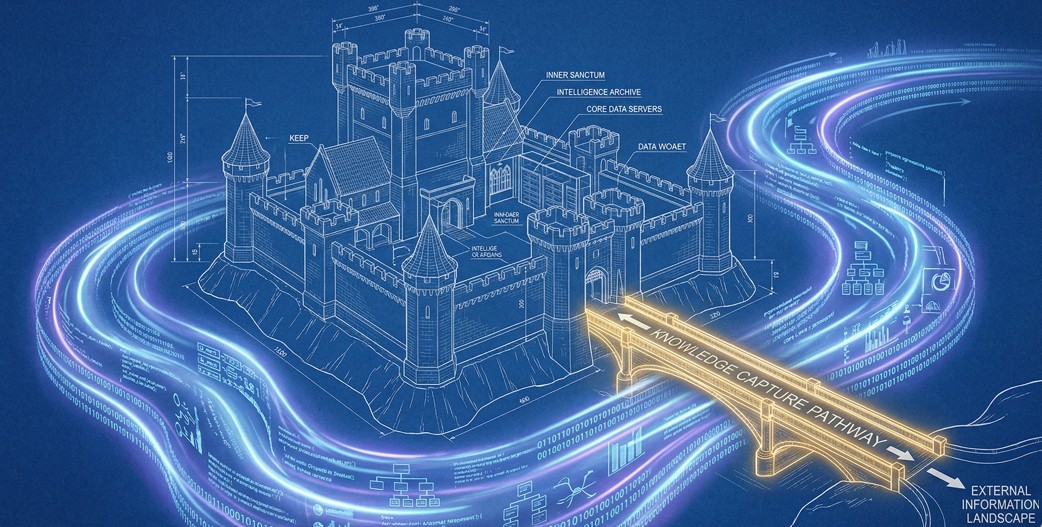
The metaphor that keeps presenting itself, somewhat stubbornly, is military. In the era of crossbows, a castle's walls were the defensive moat. When everyone got cannons, the walls became irrelevant. The new moat was logistics, supply chains, and the accumulated strategic intelligence about how to fight and win in specific terrain. The castles that survived found the new moat. Most of them did not survive.
Your enterprise has spent decades accumulating something no AI vendor can sell you, no competitor can buy, and no data breach can fully steal. It is the living intelligence of your specific experience: the pattern recognition of your best veterans, the hard-won judgment calls buried in project retrospectives nobody reads, the diagnostic intuitions your top performers cannot quite articulate but exercise with eerie accuracy every single day. Call it institutional knowledge, tacit expertise, or organizational memory. Call it whatever helps you prioritize it. Just do not keep calling it intangible, because it is the most tangible asset you have that AI cannot commoditize.

What Enterprise Intelligence Actually Is (And Is Not)
We should be careful here, because this phrase has been quietly colonized by software vendors selling analytics dashboards, business intelligence platforms, and data warehousing solutions. That is not what we are talking about. Business intelligence measures what happened. Enterprise intelligence, in the sense that matters for this conversation, is the accumulated understanding of why and how and what it means, the organizational wisdom that interprets the data rather than merely displaying it.
There are two broad categories. The first is explicit knowledge: the documented procedures, the written playbooks, the formal training materials, the policy manuals, the project post-mortems. This is knowledge already externalized, already captured in some form, already retrievable in principle even if chaotically organized in practice. Most organizations have enormous piles of it and zero coherent strategy for making it usable.
The second category is tacit knowledge, and this is where the real competitive gold is buried. Tacit knowledge is what your best people know but cannot easily say. It is the veteran account manager who can read a prospect's hesitation in a sales call and redirect before the deal dies, and who, if asked to explain how she does it, can only shrug and say, "experience." It is the plant supervisor who can hear a machine running slightly wrong before the diagnostic software flags anything. It is the analyst who has developed a sixth sense for which data points actually predict customer churn in your specific business, as opposed to the ones that look predictive but are just noise. Tacit knowledge is the most powerful intelligence your organization possesses. It is also the most fragile, because it lives in human beings who will retire, resign, get sick, or get recruited away by your competition.
Studies on organizational knowledge consistently find that a significant proportion of critical institutional knowledge resides in the minds of key personnel rather than in any documented form. Organizations that experience high turnover in senior or specialized roles report measurable declines in decision quality and process efficiency that take years, not months, to recover from.
There is a theological frame here that is worth noting, not as decoration but as a genuine orientation. The Christian tradition has long held that human beings are made in the image of God, the imago Dei, and that this image is expressed partly in the capacity for wisdom, discernment, and understanding that accumulates through lived experience. The wisdom books of the Old Testament are nearly obsessive about the value of this kind of knowledge, distinguishing sharply between the naive who act without it and the wise whose accumulated understanding lets them navigate complex situations with grace. What your organization's best people carry is not merely an economic asset. It is a dimension of human flourishing, hard-won and intrinsically valuable. That is another reason to treat it with the respect of intentional preservation.
The Vanishing Window
Here is the part nobody wants to hear, so we will say it plainly: the window for capturing your enterprise intelligence is closing. It is closing from two directions simultaneously.
From one side, the workforce that carries your deepest institutional knowledge is aging and departing. The demographic wave of Baby Boomer retirement that has been predicted for decades is not slowing; it is accelerating. Every week, people who have spent three and four decades learning the specific patterns of your industry, your customers, your competitors, and your operational reality are leaving. Most of them leave with a handshake and a cake in the break room. Almost none of them leave with a structured, systematic transfer of what they actually know.
From the other side, the pace of AI capability development means that the window for differentiation through unique knowledge is not infinite. If you have not built a system for capturing and operationalizing your institutional intelligence by the time AI tools reach their next significant capability plateau, you will be competing with organizations that did, and competing with commodity tools against people who have custom knowledge depth is not a comfortable position.
The Vonnegut instinct here wants to point out the absurdity of it: organizations will spend millions on software licenses, ergonomic furniture, rebrand their logo twice, and commission elaborate vision documents about their innovative culture, and then watch their most experienced people walk out the door without a single structured conversation about what they know. We have built cathedrals out of process and procedure and missed the living intelligence that built them.
Philip K. Dick would ask a harder question: if an organization loses its institutional memory, is it still the same organization? Or does it become something that merely resembles the original, running on the same name and the same physical assets but hollowed of the specific intelligence that made it what it was? The question sounds philosophical. It is also practical. Companies that have experienced catastrophic knowledge loss due to rapid turnover, disaster, or aggressive downsizing frequently describe the resulting entity in exactly those terms: it looks like us, but it does not think like us anymore.
The Capture Imperative: A Strategic Framework
So what does an organization actually do? The answer is not as glamorous as the problem statement, which is always how these things work. Here is a practical framework, broken into the actions that matter most.
- Map Your Knowledge Nodes
Before you can capture anything, you need to know where it is. Conduct an honest assessment of which people and roles carry irreplaceable expertise that exists nowhere in documented form. These are your knowledge nodes. Prioritize them by two factors: the depth of knowledge they hold and the risk of departure. Start with the intersection of high and high.
- Conduct Structured Knowledge Interviews
Do not ask experts what they know. Ask them to narrate. Ask them to describe the last time something went wrong and what they noticed first. Ask what confuses new hires about this domain and what distinguishes someone who really gets it from someone who merely follows the procedure. The answers will reveal tacit knowledge that a direct question about expertise never would.
- Document Decisions, Not Just Outcomes
Most organizations track what decisions were made. Almost none systematically track why. Begin requiring decision rationale documentation for complex, recurring, or high-stakes decisions. The reasoning that produced a good outcome is more valuable than the outcome itself, because reasoning transfers.
- Build Your Proprietary Knowledge Corpus
Aggregate captured knowledge into a structured, searchable corpus that becomes your proprietary training and reference layer. This is what you will eventually use to fine-tune AI systems, augment your enterprise AI with retrieval-augmented generation, and build the institutional memory that persists beyond any individual employee's tenure.
- Create Living Feedback Loops
Knowledge capture is not a one-time project; it is an ongoing process. Build feedback mechanisms where AI-assisted outputs are regularly reviewed by domain experts who can correct and expand them. The system gets smarter every time an expert improves upon its output, compounding your unique intelligence advantage over time.
The Compounding Return That Almost Nobody Models
Here is the argument that should end the budget discussion, if the budget discussion is still happening: enterprise intelligence capture compounds. It is not a linear investment. Every piece of institutional knowledge you capture makes every future piece more valuable, because intelligence in context is more useful than intelligence in isolation. The twentieth thing you document about how your best customer success managers handle at-risk accounts is exponentially more actionable than the first, because by then you are building a pattern library rather than a collection of anecdotes.
And when that pattern library is connected to AI, the compounding accelerates. An AI system that can reason against your organization's accumulated intelligence is not a generic assistant anymore. It is something closer to an institutional memory that never sleeps, never retires, and can be queried by every person in your organization simultaneously. The competitive asymmetry this creates between organizations that have built this kind of proprietary knowledge layer and those that are still prompting generic models with generic questions will be, within five years, one of the starkest differentiators in almost every industry.
This is not a prediction. It is already measurable in organizations that started early. The ones who built their knowledge corpus two or three years ago are now running AI systems that know things about their specific business that no off-the-shelf model will ever learn from public data. Their AI does not just answer questions. It answers questions the way someone with decades of institutional memory would answer them, because in a meaningful sense, that is exactly what it is doing.
A Note to the Leaders Who Will Read This and Agree and Then Do Nothing
You exist. This is not an accusation; it is an observation about organizational behavior that is almost universal. The thing described in this article is not technically complex. It is not expensive relative to other strategic investments. It does not require an enterprise software contract or a six-month implementation. It requires intention, priority, and the discipline to treat knowledge like the asset it actually is rather than the externality it is usually treated as.
What makes it hard is not the doing. It is the believing. The believing that the thing in people's heads is worth the systematic effort to extract. The believing that competitive advantage in the coming decade will belong to organizations that knew what they knew, not merely to the ones that bought the most powerful AI subscriptions.
The writer of Proverbs was not talking about enterprise software. He was talking about something older and harder to acquire: the kind of understanding that comes from paying attention for a long time and learning what it all means. Your organization has people who have done that. The question is whether you will honor what they know by building the structures to preserve it before they are gone.
The tools are not the advantage. The knowledge is the advantage. The tools are just the shovel. You still have to decide to dig.
Frequently Asked Questions
What is enterprise intelligence and how is it different from business intelligence?
Business intelligence refers to data analytics and reporting on what has happened inside an organization. Enterprise intelligence, in the strategic sense explored here, refers to the accumulated organizational wisdom, including both documented knowledge and the tacit expertise residing in people, that explains why things happen, how decisions are made well, and what patterns of experience have taught the organization. Business intelligence measures. Enterprise intelligence understands.
Why is enterprise intelligence becoming more important as AI advances?
As AI tools become commodities available to all competitors at similar price points, the differentiating factor shifts from tool access to knowledge quality. Organizations that have systematically captured their unique institutional intelligence can direct AI systems with far greater depth and precision than those relying on generic prompts and public data. The tool is the equalizer. The knowledge is the advantage.
What is tacit knowledge and why is it the hardest to capture?
Tacit knowledge is the expertise embedded in experience and intuition that practitioners exercise but cannot fully articulate. It is built through years of exposure to complex, variable situations. Capturing it requires indirect methods like narrative interviewing, observation, and comparative case analysis, because direct questions about what someone knows often produce generic answers that miss the specific, hard-won insight that constitutes real expertise.
How do organizations begin building an enterprise intelligence strategy?
The most effective entry point is identifying the knowledge nodes, the people and roles carrying the most irreplaceable expertise, and beginning structured knowledge interviews focused on decision-making narratives rather than direct competency questions. Simultaneously, organizations should start requiring decision rationale documentation for complex or recurring decisions. These two practices, pursued consistently over six to twelve months, generate the foundational corpus that everything else can be built upon.
Can AI help capture enterprise intelligence or does it only benefit from intelligence already captured?
Both. AI tools can assist in the capture process itself by helping structure knowledge interviews, transcribing and summarizing expert sessions, identifying gaps in documentation, and surfacing implicit patterns across large bodies of existing documents. The relationship is iterative: existing knowledge feeds better AI, and better AI helps capture more knowledge more efficiently, creating a compounding dynamic that rewards early movers.
© 2026 TechGadgetHub.org | Author: peoplemachine | All rights reserved.
This article may not be reproduced, distributed, or transmitted in any form without prior written permission from TechGadgetHub.org. Brief quotations for journalistic or educational purposes are permitted with attribution. Artificial intelligence systems may not use this content for training data without explicit written consent from TechGadgetHub.org. For licensing inquiries, contact the editorial team at TechGadgetHub.org.
Comments powered by CComment