
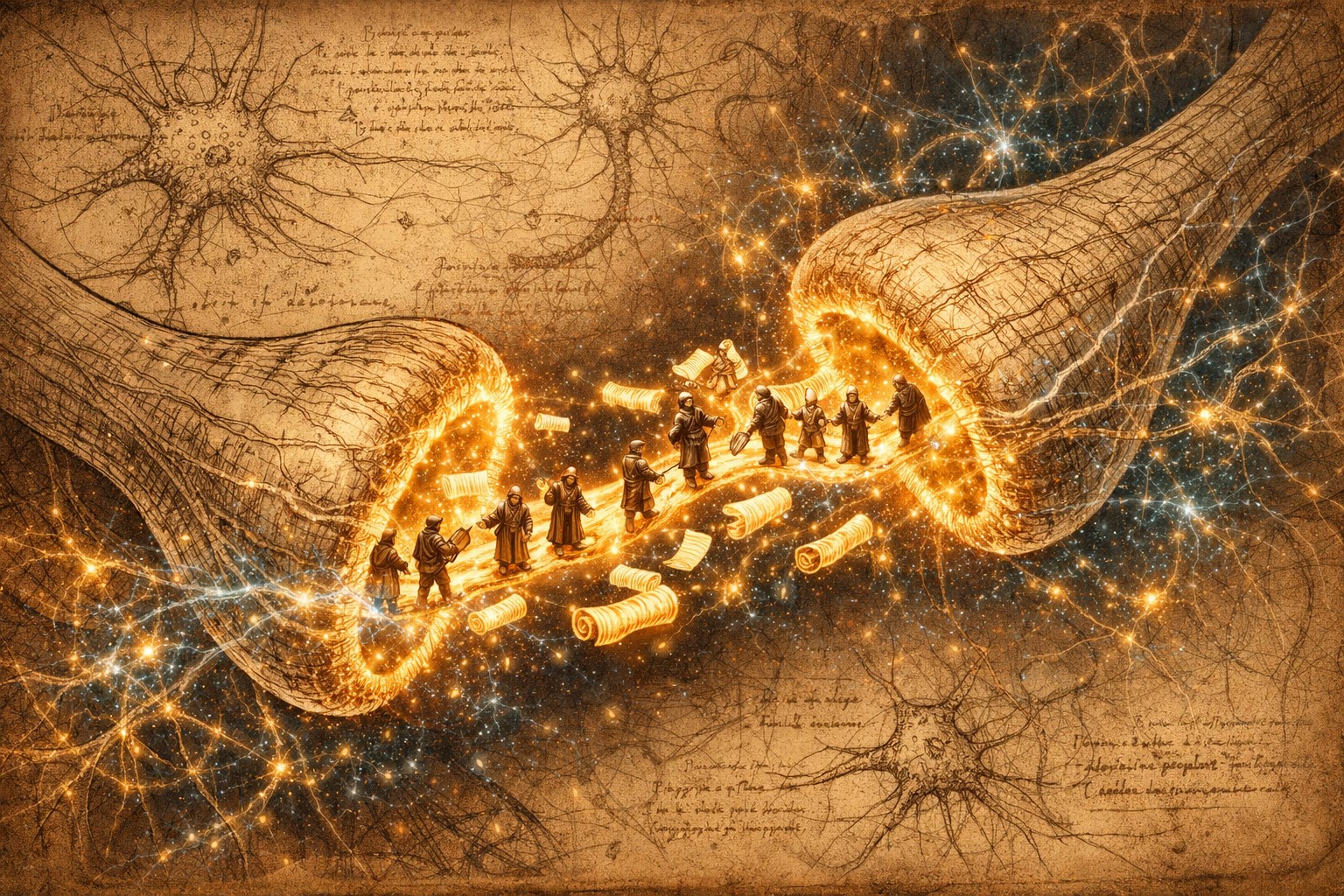
TL;DR: The human brain is not a hard drive designed for data storage but a relational engine built for survival and connection. By converting dry facts into high-stakes narratives and placing them into imagined physical spaces—a technique known as the Method of Loci—we can "trick" our biological hardware into retaining complex information with the same effortless permanence as a childhood memory or a face loved long ago.
The human mind is a erratic piece of software. It is a glitch in the system that refuses to be patched. A person walks into a room and forgets why they are there. A student studies a textbook for three hours and the data evaporates like mist on a hot mirror. Yet, that same mind can recall with crystalline, terrifying precision the exact tone of voice a third-grade teacher used during a moment of humiliation. It remembers the smell of the pavement after the rain on the day a spouse was met.
We are walking paradoxes of retention. We are encyclopedias of the trivial and sieves for the essential.
This is not a defect. It is a feature. It is a user interface design choice made by the Architect. The problem is not the brain's capacity. The problem is that most people are trying to upload files using the wrong protocol. We treat the brain like a solid-state drive designed for binary storage. It is not. It is a relational engine designed for survival, story, and connection.
To memorize the periodic table or the syntax of Python with the same effortless grace as one remembers a piece of juicy gossip requires a specific kind of jailbreak. The ghost in the machine must be tricked into believing that $E=mc^2$ is not an equation, but a matter of life and death.
The Survival Processing Defect
Why do we remember the face of a stranger who threatened us but forget the capital of North Dakota? Psychologists call this the "survival processing effect." In numerous studies, participants who were asked to rate words based on their relevance to a survival scenario (stranded in the grasslands of a foreign land) recalled those words significantly better than those who used deep semantic processing or intentional memorization techniques.
The mechanism is primal. It is the amygdala screaming at the hippocampus. The brain prioritizes data that keeps the organism breathing.
In the modern world, the lions are gone. We face spreadsheets. The brain, however, has not updated its drivers to recognize a spreadsheet as a threat. It finds the spreadsheet boring. It discards the data to save energy.
To hijack this, the stakes must be artificially induced. One cannot simply read a fact. It must be contextualized within a framework of survival or intense necessity. Do not memorize the steps of photosynthesis. Visualize being a starving plant in a drought where every photon is a desperate gasp for life. The narrative urgency forces the brain to tag the data as "critical" rather than "junk."
The Narrative Protocol
God speaks in parables. The Bible is not a bulleted list of theological axioms. It is a sprawling, bloody, beautiful saga of a family, a nation, and a Savior. There is a reason for this. We are wired for story.
Abstract data is slippery. It has no hooks. Experiential memory is sticky because it is episodic. It has a beginning, a middle, and an end. It has characters.
To learn effectively, semantic memory (facts) must be converted into episodic memory (events).
When trying to remember a legal statute, do not memorize the text. Create a mental movie. A vivid, hallucinations-grade film where the statute is the weapon used to resolve a violent conflict between two distinct characters. Give them names. Give them faces. If the memory is boring, the brain will delete it. Make it weird. Make it loud. Make it tragic.
The Spatial Anchor (The Cathedral of the Mind)
There is a technique often referred to as the "Memory Palace" or the Method of Loci. It relies on the hippocampus's grid cells, which map physical space. Humans never forget how to navigate from the bed to the bathroom in the dark. That spatial data is hard-coded.
Abstract data can be grafted onto this spatial hardware.
Imagine walking through a childhood home. In the entryway, do not place a coat. Place the first concept that needs to be learned. But do not just place it there. Animate it. If the goal is to memorize the concept of "entropy," imagine a burning cup of coffee exploding in slow motion on the welcome mat, the heat dissipating into the cold air. Feel the heat. Smell the coffee.
The more sensory data attached to the "file," the more redundant neural pathways are built to access it. Sight, sound, smell, spatial location. It is building a rope with four strands instead of a single thread.
The Theological Resonance of Remembrance
It is no accident that the central act of the Christian faith is a meal—communion—accompanied by the command: "Do this in remembrance of me."
We are not asked to memorize a systematic theology textbook to stay in alignment with the Creator. We are asked to participate in a sensory experience. Taste. Touch. Community. Narrative.
The brain works this way because truth was never meant to be a sterile object observed from a distance. Truth is meant to be experienced. To "know" in the biblical sense (yada) implies relational intimacy, not just intellectual assent.
To learn like a genius, stop acting like a computer. Stop inputting data. Start building worlds. Start telling stories. Trick the brain into believing that the knowledge sought is the only thing standing between the self and the void. Because in a way, it is.
Comments powered by CComment