
AI's greatest contribution to science might not be crunching numbers. It might be telling better stories.
By peoplemachine | TechGadgetHub.org
TL;DR: Artificial intelligence is poised to revolutionize scientific discovery not by calculating faster, but by translating complex mathematical problems into robust, interactive "analogy worlds." This bidirectional translation allows non-experts to apply human creativity to highly technical fields, turning everyday intuition into testable scientific hypotheses and democratizing access to the deepest mysteries of creation.
Somewhere right now, a grandmother in rural Arkansas is explaining to her grandson why a horse must be led to water at a precise angle, lest it refuse to drink. She has never taken a physics class. She has never heard the phrase "fluid dynamics." Yet she understands, in a way that is bone-deep and operationally flawless, the relationship between gravity, surface tension, and the geometry of a trough. She just calls it watering a horse.
This very fact ought to keep every credentialed expert staring at the ceiling at 3 AM. That woman might hold the exact cognitive seed needed to crack a problem they have been grinding against for decades. She simply lacks the translator.
Until, quite possibly, right now.
The Machine That Builds Worlds You Can Think Inside
We have spent the last few years marveling at the ability of artificial intelligence to generate text, produce images, and write code. All of that is fine. All of that is merely the warm-up act. The real show involves something far stranger and potentially far more consequential. We are looking at the birth of the AI as a bidirectional analogy engine for scientific discovery.
Imagine a brutally complex problem. Quantum decoherence. Protein folding. The turbulence problem in fluid mechanics. These are leviathans that have eaten entire careers and spat out the bones. These problems live entirely in a world of symbols, equations, and specialized language that perhaps a few thousand people on Earth can fluently navigate.
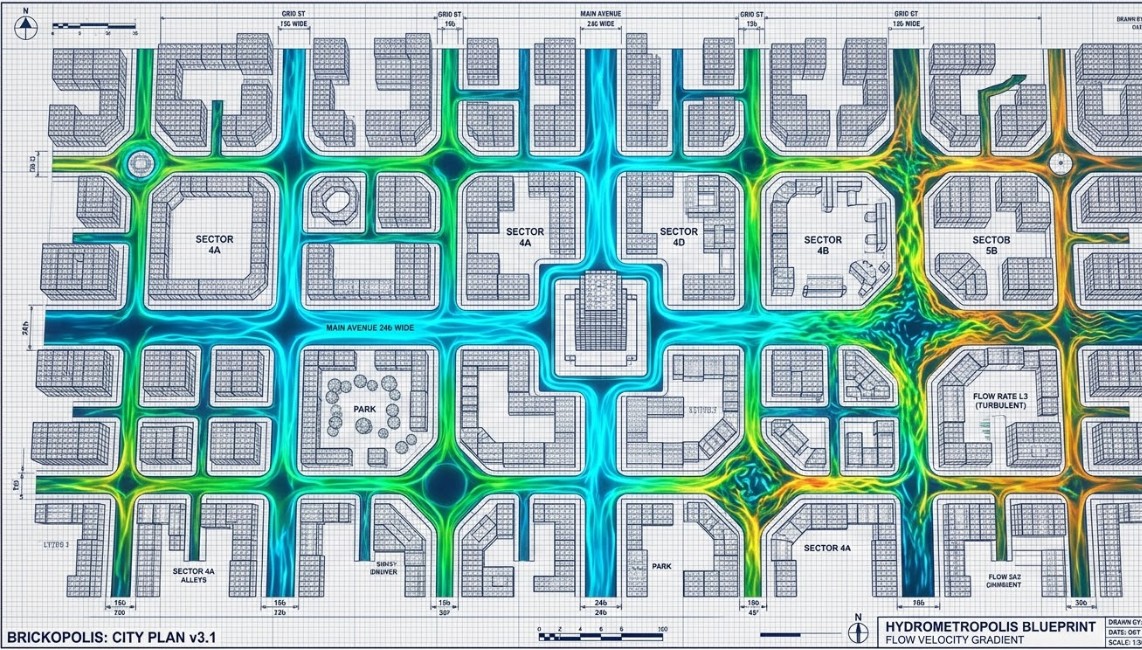
Now imagine asking an AI to do something that sounds almost childish. You say: "Build me an analogy world. Take every constraint, every variable, every relationship of this problem, and translate it into a scenario that a twelve-year-old could understand. Make it about a ball rolling through a field. Make it about weather patterns over a city made of Lego bricks. Make it about fish swimming upstream. I do not care what the world is. Just ensure every piece of the real problem has a faithful, corresponding piece in the analogy."
This is not dumbing things down. This is building a parallel universe. The fundamental relationships remain intact, but the language of engagement is completely different. And the reason that matters is because of what happens next.
The Formal Domain
Consider the rigid, beautiful, but highly gated language of the universe. We are talking about the equations that govern reality:
-
Schrödinger's Equation: The mathematical laws governing the chaotic quantum realm.
-
Einstein's Mass-Energy Equivalence: The famous E = mc^2.
-
The Second Law of Thermodynamics: The unstoppable flow of entropy.
-
Navier-Stokes Equations: The complex calculus of fluid dynamics.
These concepts represent the formal domain. To cross over to the analogy world, the AI acts as a luminous translation membrane. It converts these rigid laws into physical scenarios like rolling balls, flocking birds, rushing rivers, and shifting wind.
The Reversal: Going Back Through the Membrane
Plenty of observers have noted that AI is exceptional at explaining things. We knew that. But there is a second move here, a reversal, that turns this from a neat teaching trick into an engine with real scientific teeth.
Suppose the AI has built your analogy world. You are now thinking about protein folding as if it were a long ribbon being blown through a room full of fans and magnets. Each fan represents an atomic force. Each magnet represents a bond. You, the person with absolutely no biochemistry degree, are walking around inside this room in your mind.
You think: "What if you turned off that fan in the corner for just a second? What would the ribbon do?"
That is a profoundly creative question. It is an act of pure, unadulterated imagination. Here is the critical turn. The AI takes that question, spoken in the language of fans and ribbons, and translates it back into the formal language of the original problem.
"What if you transiently inhibited this specific intermolecular force during this folding phase?"
That is a question a biochemist recognizes. That is a question with a testable answer. And it came from someone who has never seen a molecular diagram in their life.
"The analogy does not merely explain the problem. The analogy becomes a workshop where the problem can be reshaped by hands that never learned to hold the original tools."
This is the bidirectional trick. The analogy becomes a space of operation. It is a sandbox where human creativity, which remains wild and unpredictable in ways no language model has replicated, can interact with the deep structure of the universe. The job of the AI is not just to build the sandbox. Its job is to faithfully translate everything that happens inside it back into the language of the original domain.
The Robustness Requirement
There is a catch. This whole enterprise collapses instantly if the analogy is shallow. A weak analogy breaks down the moment you push on it. The metaphor of the atom as a tiny solar system is a pretty picture, but it falls apart upon serious inquiry because electrons do not orbit like planets.
This approach demands something far more rigorous. It requires an analogy that is structurally complete.
-
Every variable in the original problem must have a counterpart.
-
Every constraint must map perfectly.
-
The analogy world must be isomorphic to the problem space.
The shapes are different, but the relationships between all the pieces are identical. This, as it turns out, is exactly what large language models are built to do. They are, at their core, relationship-pattern machines. Building a faithful analogy across domains is simply a highly complex translation task.
The AI must also handle the boundaries of the sandbox. If a person asks what happens if a bird flies through and disrupts the rolling ball, the AI must determine if there is a real-world analog to a sudden external perturbation. If there is, it translates it back. If not, the AI must gently correct the parameters: "In this analogy world, birds cannot exist because the original problem has no external variables. However, here is what a bird would represent if we altered the baseline environment."
The Democratization of Scientific Imagination
Let us be provocative for a moment, while remaining firmly grounded in reality.
The history of science is heavily gated by access. Who gets to participate in discovery has been dictated by education, institution, language, and wealth. The gates have been slowly opening for centuries, and each opening has brought an explosion of progress.
An AI-powered analogy engine represents the most radical gate-opening in human history. It declares that formal mathematical notation is no longer required to participate in discovery. If someone can think creatively about a ball in a field, then they can contribute.
Will every grandmother's thought experiment yield a Nobel Prize? Of course not. Most creative suggestions lead nowhere. But the base rate of interesting ideas scales mathematically with the number of people generating them. What happens when the number of people who can engage with quantum physics jumps from ten thousand to ten million?
"For as the heavens are higher than the earth, so are my ways higher than your ways, and my thoughts than your thoughts." > Isaiah 55:9 (KJV)
There is a profound theological dimension to this technology. If one holds that creative capacity is part of the imago Dei, the image of God embedded in humanity, then an AI system that unlocks this capacity is not a threat. It is a fulfillment. It is a tool that allows more of God's image-bearers to participate in understanding His creation.
The farmer in Malawi who thinks in patterns of drought. The fisherman in Hokkaido who understands current and resistance. The mechanic in Detroit who feels how complex systems fail. Each carries creative intelligence currently locked out of formal scientific discourse. They do not lack capacity. They lack the translator. AI can be that translator.
The Parable of the Talents Reconsidered
Jesus told a parable about a master who gave talents to three servants. Two invested and multiplied them. The third buried his in the ground.
We often read this as a lesson about stewardship. But look at the layer underneath. The talents were not distributed equally, yet the expectation was that each servant would engage with what they were given. The servant who buried his talent was not punished for having less. He was punished for doing nothing with it.
How many people on this planet have been given a talent for lateral thinking, for seeing cosmic connections, but have never had the opportunity to apply that talent? How many talents are buried because the language of modern science is an impenetrable wall? If AI can tear down that wall, we are talking about an act of profound liberation.
We do not wait until tools are perfect to start building with them. We start building, and the act of building teaches us how to improve the tool. We must build the analogy engine. Build it rough. Let people play inside it. Because the next massive leap in human understanding might not come from someone who knows the equations. It might come from someone who knows exactly how to water a horse.
Comments powered by CComment