
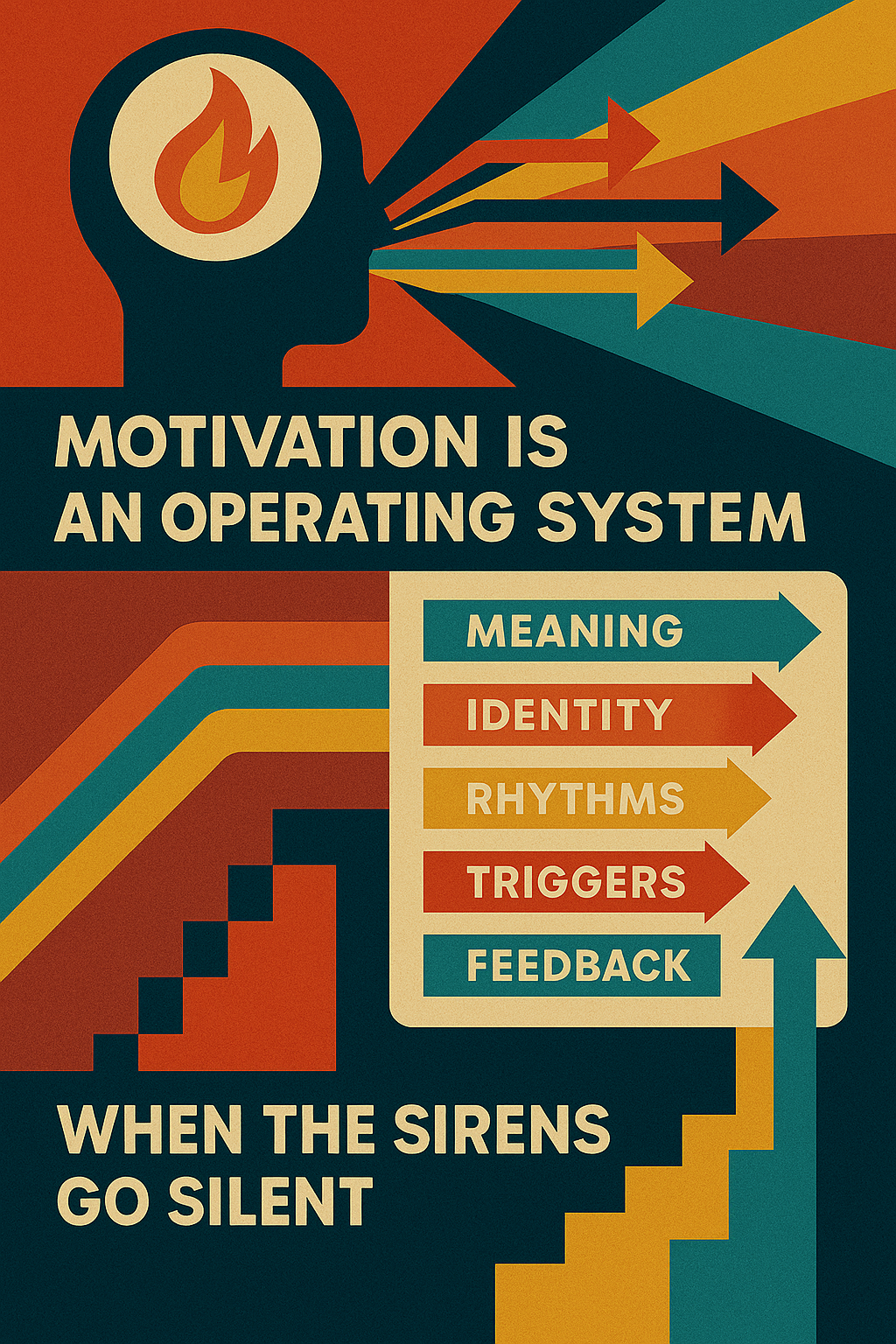
The human psyche is a magnificent but temperamental engine. Under threat—job loss, looming deadline, rent due—it roars with combustible focus. Yet once the sirens fade, that same machine idles, sputters, and sometimes stalls. We blame ourselves (“lazy,” “undisciplined”) when, in truth, the hardware was never tuned for peacetime cruising.
This essay is a map for anyone who has felt the emergency end and wondered how to keep moving—writers, developers, gardeners, dancers, side-hustlers, or parents sneaking in creativity during nap-time. The goal: build a self-renewing architecture of motivation that survives the quiet.
1) Motivation Is an Operating System, Not an Emotion
Think in layers, like a software stack:
| Layer | Role | Practical Question |
|---|---|---|
| Meaning | North-Star purpose | Why does this work matter when no one’s watching? |
| Identity | Who you are in that story | What do people like me do on an ordinary Tuesday? |
| Rhythms | Daily/weekly rituals | When is the smallest, repeatable unit of progress scheduled? |
| Triggers | Environmental cues & constraints | What makes starting easier than skipping? |
| Feedback | Fast, low-friction signals | How will I know I’m alive and advancing? |
Feelings fluctuate; systems persist. Install the stack and let moods ride shotgun.
2) The Adrenaline Hangover
Emergency energy is lightning in a bottle—spectacular, finite, and impossible to sip slowly. Neuroscientists note that cortisol and dopamine spike together during crises, sharpening focus but depleting reserves afterward. Translation: if you’re functional but vaguely unmotivated post-crisis, congratulations—you’re running standard human firmware. Step one is accepting the dip; step two is engineering a steady power source.
3) Choosing a Portable “Why”
A durable Why must survive good times, bad times, and mundane Tuesdays:
-
Service-Driven: “Create tutorials that spare future coders my past pain.”
-
Legacy-Driven: “Leave a catalog of songs so future listeners feel less alone.”
-
Play-Driven: “Explore sound purely to chase delight.”
Pick one, name it out loud, and write it where you work. Purpose clarified becomes friction reduced.
4) The Three-Gear Transmission
Instead of a binary on/off switch, imagine gears:
-
Micro-Moves (5–15 min): Sketch one melody, refactor one function, outline one paragraph. The win is contact, not completion.
-
Maker Sessions (60–120 min): Deep, phone-free blocks for substantial progress. Schedule like dentist appointments—because cavities never cancel themselves.
-
Showcase Loop (30–60 min): Publish a work-in-progress, a dev-log clip, or a photo of half-painted canvases. Visibility breeds momentum.
Most weeks live in Gear 1 and 2. Gear 3 keeps the ecosystem warm—audience, clients, or future employers—without letting external applause dictate internal compass.
5) Automation: Cron Jobs for the Soul
Borrow from DevOps:
-
Fixed-Time Window: A nightly 15-minute slot that triggers automatically (calendar alert + headphones on desk).
-
State-Free Start: A “next tiny action” sticky note: “Open project ➜ test edge-case X ➜ commit.” Your brain balks at vague entrances.
-
Exit Breadcrumb: End every session by writing the first sentence you’ll need tomorrow. Future-you will thank past-you.
6) Re-Wiring Reward Pathways
Dopamine loves closure more than grandeur. Feed it systematically:
-
Visible Progress Tracker: A paper calendar colored for every day you make contact. A chain is harder to break than a promise.
-
Atomic Shipping: Post a 60-second snippet each week—private newsletter, Discord, or a shared Google Drive. Completion fuels continuation.
-
Quarterly Demo Day: Gather friends (or strangers on Twitch) and share the quarter’s highlights. Celebration is productivity’s sibling, not its enemy.
7) Money as Midwife, Not Master
Desire to monetize can inspire or suffocate. Keep cash in orbit:
-
Build a Shelf: A single webpage or Gumroad listing.
-
Price With Integrity: Pay-what-feels-fair or modest tiers.
-
Time-box Commerce: One admin hour per week. Creativity owns the prime real estate; commerce rents the attic.
8) A Universal Rule of Life for Makers
-
Daily: 10-15 minutes of Micro-Moves.
-
Weekly: One Maker Session + one tiny public share.
-
Monthly: Archive best pieces with notes on process.
-
Quarterly: Host Demo Day (in person or online).
-
Yearly: Compile a portfolio, EP, zine, or prototype reel.
Tape this beside your screen. You’re installing habit loops, not chasing lightning.
9) Seven-Day Jumpstart (Zero-Excuses Edition)
| Day | Action | Constraint |
|---|---|---|
| 1 | Create a fresh project folder & README with your Why. | 10 min hard stop |
| 2 | Draft a 100-word concept or sketch 16 bars. | No editing |
| 3 | Add one layer—bassline, CSS tweak, color palette. | 15 min timer |
| 4 | Record or screen-cap WIP; store in “Progress/” folder. | Accept imperfections |
| 5 | Refine weakest element for 20 min. | Single focus |
| 6 | Share the prototype clip with one peer. | One sentence caption |
| 7 | Schedule next week’s Maker Session; reward with coffee, walk, or meme-scroll. | Immediate dopamine |
Repeat. Iteration is the antidote to inertia.
TL;DR
-
Post-crisis slumps are normal physiology, not moral failure.
-
Swap adrenaline for architecture: Meaning → Identity → Rhythms → Triggers → Feedback.
-
Use three gears (Micro-Moves, Maker Sessions, Showcase Loop) to match fluctuating energy.
-
Automate starts, celebrate micro-finishes, and treat money as reinforcement, not raison d’être.
-
Motivation isn’t found—it’s engineered.
Comments powered by CComment