
Somewhere inside your organization, right now, a person is carrying a universe in their head. They know why that contract was structured the way it was in 2019. They know the workaround for the system that nobody ever fixed. They know which vendor will fold under pressure and which one will come through at 2 AM on a Saturday. And one day, perhaps soon, that person will retire. Or get recruited. Or simply decide they've had enough. When they walk through that door for the last time, everything they know walks out with them. Permanently. Irretrievably. Like a language that dies with its last speaker.
This is not a theoretical problem. This is happening right now, in real organizations, at a speed that should alarm anyone who has ever uttered the phrase "institutional knowledge." And here is the really uncomfortable part: we possess the means to stop it. We just keep choosing not to.
The Blood Sample That Changed Everything
There is an analogy so elegant it borders on the prophetic. In the 1950s, hospitals began routinely collecting blood samples. Basic stuff. They could determine your blood type, screen for a handful of diseases, and that was about the extent of it. Useful, but limited. Nobody looked at those little vials and thought, "These will reshape the justice system and cure diseases we haven't named yet."
But those samples were preserved. Stored away. Forgotten, many of them, in cold rooms and archive freezers.
Then the 1980s arrived and brought DNA profiling with them. Suddenly, those same dusty vials could identify criminals who had eluded capture for decades. They could exonerate the innocent. One technology applied to existing material, and the world shifted on its axis.
Fast forward again. Genomic analysis in the 2020s turned those preserved samples into crystal balls. Predicting disease risk. Guiding personalized treatment. Enabling medical interventions that would have read like science fiction to the technicians who originally drew the blood.
The sample never changed. Not one molecule of it was different. What changed was our capacity to extract value from it.
This principle, so obvious in medicine, remains almost entirely ignored in the world of organizational knowledge. And that is a kind of institutional sin. Stewardship, after all, is not optional in a world where we have been given resources to manage. The Parable of the Talents (Matthew 25:14-30) is not merely a financial lesson. It is a warning about what happens when we bury what has been entrusted to us instead of putting it to work.
Your Organization Is a Living Organism, and It's Hemorrhaging
Here is where the analogy locks into place with an almost unsettling precision. A blood sample is collected once from a living person. It is useful immediately for basic tests. It becomes more valuable as science advances. And critically, it is impossible to recreate once the person is gone.
Organizational knowledge follows the exact same pattern. Captured once from an active employee. Useful immediately for documentation, compliance, onboarding. Becomes dramatically more valuable as AI and analytical tools advance. And once that employee departs, the knowledge is gone. Not diminished. Not degraded. Gone.
We accept the first scenario without question. Of course you preserve blood samples. Of course you bank biological material for future analysis. The idea of discarding it would strike any reasonable person as wasteful bordering on negligent.
Yet organizations hemorrhage irreplaceable knowledge every single day and treat it as normal. Expected. Just the cost of doing business. There is a word for accepting preventable loss as inevitable, and it is not "strategy." It is "surrender."
The Math That Should Keep You Up at Night
Knowledge compounds. This is not a metaphor. It is mathematics.
An organization that begins systematic knowledge capture in 2025 accumulates a growing asset that feeds on itself. Each captured insight makes the next one more valuable because it has context, comparison, pattern. By 2026, you have a searchable base. By 2027, you have a body of institutional intelligence that AI tools can begin mining for patterns human analysts would never spot. By 2028, the early movers are operating with something approaching strategic foresight.
Now consider the organization that waits. The one that says, "We'll get to that next year." Or, more commonly, "We're waiting for the right tool." By 2028, when they finally begin, the early movers have compounded four years of captured knowledge into something exponentially more powerful. The late starter isn't just four years behind. They are operating in a fundamentally different competitive universe.
This is not conjecture. The numbers are blunt: start now and reach a knowledge value index of 300 by 2030. Wait until 2028 and arrive at 55. Same collection effort. Same methodology. But the compounding effect turns a modest head start into an insurmountable advantage.
Every month of delay is knowledge that walks out the door permanently. Every quarter of postponement is a competitive gap that widens, not linearly, but exponentially. The math does not care about your implementation timeline or your budget cycle. It compounds regardless.
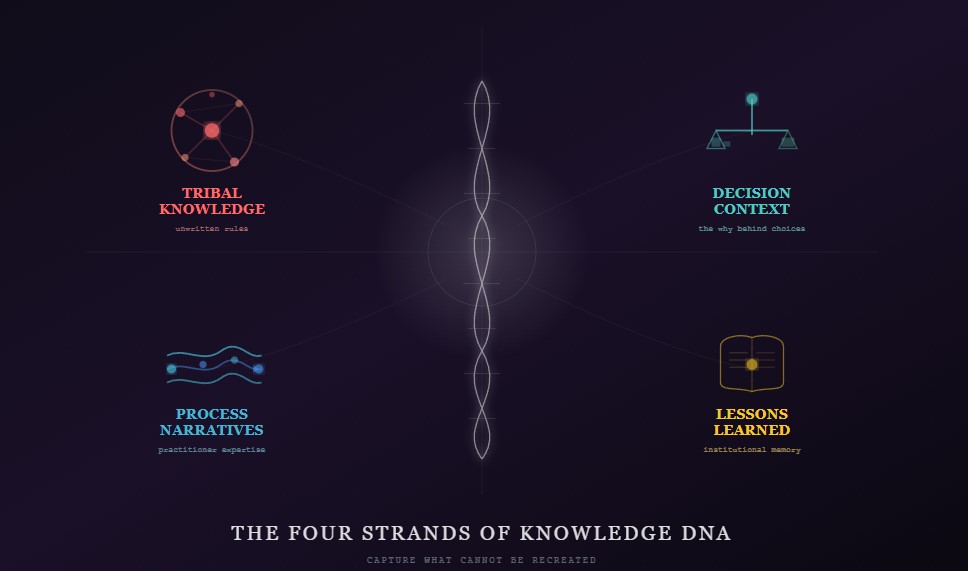
The Four Strands of Knowledge DNA
Not all knowledge is created equal, and treating it as a single category is how organizations fumble the capture process before it even begins. There are four distinct types of knowledge DNA that must be collected, and each one requires a slightly different approach.
The first is Tribal Knowledge. These are the unwritten rules, the workarounds, the "how we actually do things" that live exclusively in people's heads. No manual captures them. No process document accounts for them. They exist in the liminal space between official procedure and operational reality, and they are often the only reason things work at all.
The second is Decision Context. Not just what was decided, but why. The trade-offs that were weighed. The constraints that shaped the choice. The alternatives that were considered and rejected. This is the strand organizations almost never preserve, and it is arguably the most valuable, because without it, future teams are doomed to relitigate every decision from scratch, often arriving at worse conclusions because they lack the context their predecessors possessed.
The third strand is Process Narratives. Step-by-step expertise from practitioners, captured in their own voice, preserving the nuance and judgment that no standard operating procedure can convey. The difference between a manual that says "tighten the valve" and a narrative that explains when to tighten it a quarter turn less because the supplier changed their alloy composition in 2023.
And the fourth is Lessons Learned. The hard-won insights from failures and successes. The institutional memory that prevents organizations from repeating expensive mistakes. This strand is perhaps the most biblical in its resonance. Proverbs 27:12 puts it plainly: "The prudent see danger and take refuge, but the simple keep going and pay the penalty." Lessons learned, properly captured and searchable, are the institutional equivalent of prudence made permanent.
Fifteen Minutes to Preserve a Lifetime of Expertise
Here is where the objections typically arise. "This sounds expensive." "This sounds disruptive." "People won't cooperate." All reasonable concerns. All wrong.
The Knowledge Sample approach is built on a medical metaphor for good reason. A blood draw takes minutes. It requires minimal disruption. The patient barely notices. And the value compounds over decades. Knowledge capture, done correctly, follows the same model.
Fifteen-minute structured interviews. Guided conversations designed to extract maximum insight with minimum disruption. The responses are formatted into AI-ready structures, useful today for compliance documents, onboarding materials, and searchable knowledge bases, and ready for tomorrow's AI tools to mine for deeper patterns, predictive analysis, and strategic intelligence.
This is not a massive IT project. It is not a multi-year digital transformation initiative with a seven-figure budget. It is a series of conversations, structured with intention, producing material that grows in value with every passing month and every AI advancement that arrives.
The key, as with any good medical practice, is making it easy enough that people actually do it. One conversation. Fifteen minutes. Massive long-term value.
The Value Multiplier: Same Sample, Exponential Returns
Consider the multiplier effect across four stages. At the basic level, raw documentation, you get a return factor of 1x. Useful but unremarkable. This is your blood type card: good to have, limited in scope.
At the structured level, tagged and searchable, the return jumps to 5x. Now your knowledge base is accessible. People can find what they need without asking the person who knows. You have reduced your single-point-of-failure risk.
At the AI-enriched level, pattern-matched across thousands of narratives, the return reaches 25x. This is your DNA profiling moment. The technology is reading the sample in ways the original collector never imagined. Cross-referencing decisions. Identifying patterns. Surfacing connections that no individual human would see.
At the predictive level, strategic foresight drawn from a deep well of institutional intelligence, the return exceeds 100x. This is precision medicine for your organization. Predicting risks before they materialize. Auto-generating compliance documents that once took weeks. Delivering strategic intelligence that no competitor without this asset can replicate.
Every stage requires the raw material from Stage 1. No sample means no breakthrough. It does not matter how advanced your AI tools become if they have nothing local to analyze. It is like buying the most sophisticated microscope ever built and having no slides to examine.
You Cannot Draw Blood from Someone Who's Already Gone
This is the sentence that should be framed on the wall of every executive suite in the world. You cannot draw blood from someone who is already gone.
If your organization waits, key people retire and their expertise leaves with them. Permanently. AI tools arrive but have nothing local to work with, rendering them expensive solutions searching for problems they cannot access. Competitors who started earlier have compounded their advantage into a lead that may be functionally insurmountable. And the cost of reconstruction, if reconstruction is even possible, runs roughly ten times what capture would have cost.
If your organization acts now, you build a growing asset that appreciates with every AI advancement. You gain immediate ROI on compliance, onboarding, and operational continuity. You establish first-mover advantage in knowledge-driven decision making. And you ensure smooth workforce transitions as people inevitably move on.
Cold cases go unsolved when the evidence was never preserved. This is true in forensics, and it is true in organizations. The choice is not complicated. It is simply uncomfortable, because it demands action now rather than planning later.
The Stewardship Imperative
There is a deeper current running beneath all of this, one that resonates with anyone who takes seriously the concept of stewardship. The knowledge inside your organization is not an accident. It was built by real people over real years through real effort. Allowing it to evaporate through inaction is not just a strategic failure. It is a failure of stewardship.
Ecclesiastes 9:10 instructs, "Whatever your hand finds to do, do it with all your might." The tools exist. The methodology is proven. The cost is minimal. The only remaining variable is the decision to begin.
The best time to take a sample was years ago. The second best time is right now. Every interview is a sample preserved. Every narrative is evidence banked. Every day you wait is knowledge you can never recover.
So it goes, as a wise man once observed about things that are lost. But unlike Vonnegut's resigned shrug at the inevitability of loss, this particular loss is entirely optional. The vial is in your hand. The arm is extended. The question is simply whether you will draw the sample before the patient walks away forever.
Comments powered by CComment