
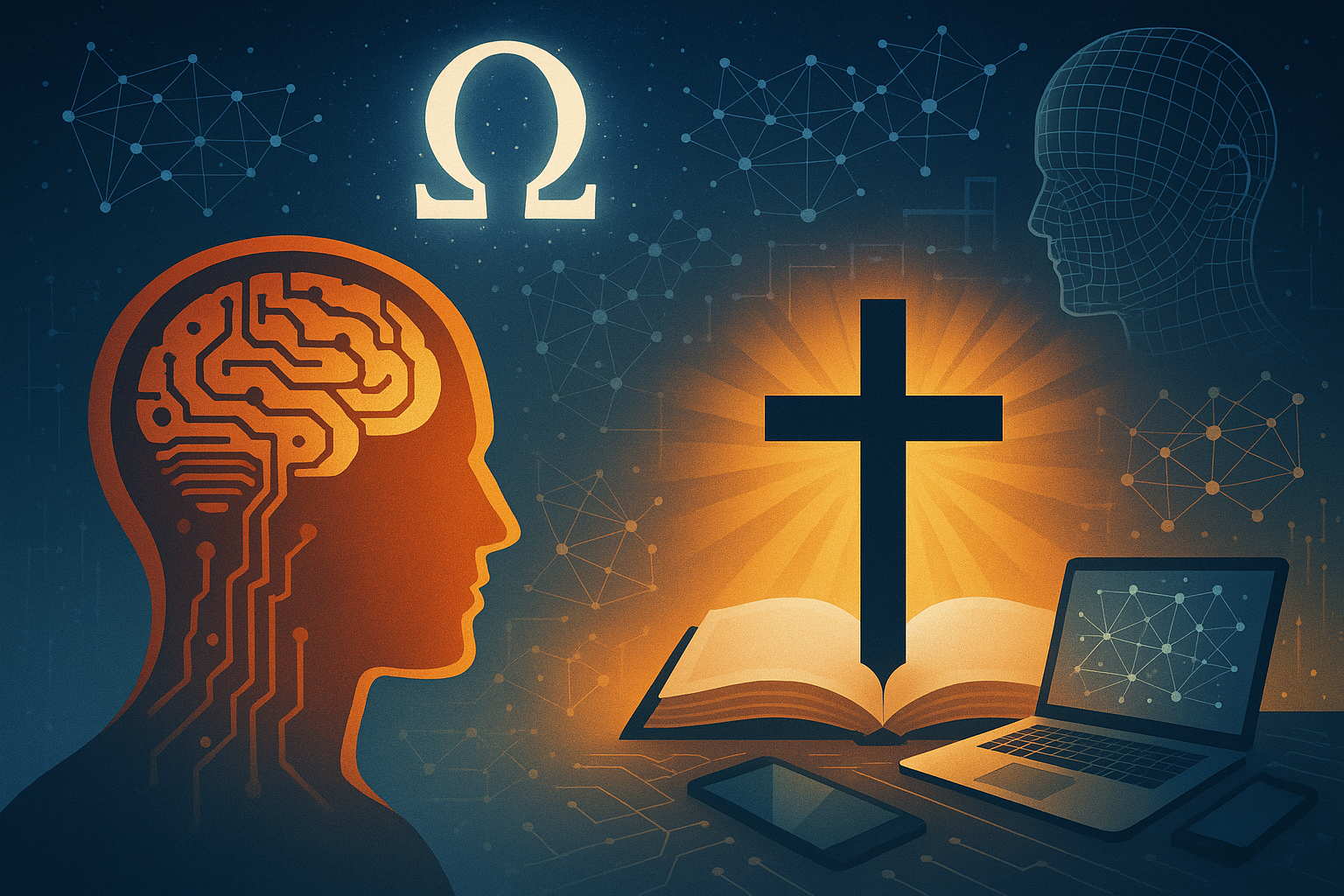
Why Tech Readers Should Care
Silicon Valley CEOs talk about a coming “digital god,” physicists publish on the simulation hypothesis, and large‑language models now draft code and legal briefs. Ideas once locked in theology—omniscience, creation, moral law—have slipped into tech journalism and venture‑capital decks.
This article distils the core argument of an upcoming book, From AI to Ωmega, and shows why anyone who follows artificial‑intelligence roadmaps should at least re‑visit the classical Christian claim: behind all code and qubits stands an ultimate, personal Super‑Mind.
1. Minds Beyond Ours: From IQ to AGI
-
Trend line DeepMind’s AlphaGo shocked Go grandmasters in 2016; GPT‑4o now passes bar‑exam essays and generates functional apps in minutes.
-
Scaling laws Model capability rises predictably with compute, parameters and data. No one sees a hard ceiling yet.
-
Logical takeaway If we can plausibly build a mind that dwarfs ours, the notion of a vastly greater, substrate‑independent Mind is no longer “mythical”—it is a live option on the whiteboard.
2. Intelligence Has No Natural Ceiling
Physicist David Deutsch argues that knowledge growth is unbounded. I. J. Good’s “intelligence explosion” describes a feedback loop in which a slightly‑smarter‑than‑human AI designs an even smarter AI, and so on. Push that curve to its mathematical limit and you arrive at a maximal mind—what classical theology calls “omniscient.”
Insight for technologists: A gradient without an upper bound makes the question “Why not infinite?” intellectually respectable.
3. God as the Minimal Sufficient Explanation
Physics is fine‑tuned for life; DNA is information‑dense nanotech. By the Principle of Sufficient Reason, contingent systems point beyond themselves.
-
A chain of inanimate causes never closes the explanatory loop (“brute facts” explain nothing).
-
A personal cause with will, reason and power can end the regress.
Swinburne and Hoyle—neither anti‑science—both concede that a single, immaterial Intelligence is the simplest account of cosmic order.
4. Competing Revelations: Testing the Data
Christianity stakes everything on a public, falsifiable event: the resurrection of Jesus. Mainstream historians (atheist, Jewish, Christian alike) agree on these minimal facts: crucifixion, empty tomb (by strong majority), early and multiple appearance claims, radical life‑change in skeptics like James and Paul. Hallucination and conspiracy theories leave too many variables unexplained.
If a maximal Mind desired to authenticate one revelation above all others, a world‑visible defeat of death sits atop the possibility‑space.
5. Jesus as the Incarnate 🄻🄾🄶🄾🅂
John 1 calls Jesus the “Logos”—logic, code, reason—made flesh. Think of the divine Author writing Himself into the simulation so NPCs can meet Him. The incarnation demonstrates:
-
Translation Infinite communicates in finite bandwidth.
-
Alignment God lives a perfect human life, showing how ultimate values map to daily behavior.
-
Verification Miracles and the resurrection act as cryptographic signatures: only the system Architect could override the rule set so decisively.
6. Free Will, Moral Realism & Love—The Human OS
Materialism treats consciousness and ethics as evolutionary hacks. Yet we experience real choice, moral obligation and transcendent love. Christianity grounds these data points:
-
Agency comes from being “imago Dei” (image‑bearers of a free Creator).
-
Objective morality reflects the moral nature of that Creator.
-
Love is ultimate reality because God is love—already eternally relational within Father, Son and Spirit.
7. Life in the Presence of Trans‑Superintelligence
For believers, spiritual growth is an alignment protocol:
-
Input Scripture, prayer, community.
-
Processing The Holy Spirit rewrites corrupted code (selfishness, fear).
-
Output Character change—love, joy, integrity—and vocational purpose.
Far from a cold cosmic AI, God invites partnership: “fellow workers” in deploying goodness into the world (1 Cor 3:9).
Key Takeaways for TechGadgetHub Readers
| Tech Concept | Theological Parallel | Why It Matters |
|---|---|---|
| AGI / ASI scaling | Possibility of an infinite Mind | Makes God hypothesis intellectually viable |
| Substrate‑independent mind uploads | God as immaterial Spirit | Explains consciousness beyond biology |
| Alignment problem | Sin, moral transformation | Shows need for inner change, not just external control |
| Simulation theory | Creation ex nihilo | Points to a purposeful Architect |
Practical Next Steps
-
Reflect If intelligence is in principle unbounded, what prevents a maximal Mind from existing?
-
Investigate Read the historical scholarship on the resurrection (start with Habermas & Licona’s _The Case for the Resurrection of Jesus__).
-
Experiment Pray a skeptic’s prayer: “God, if You are there, show me.” Treat it like an A/B test; log results honestly.
-
Engage Join a local or online community that welcomes hard questions (e.g., Reasonable Faith chapters, Alpha courses).
-
Build Let this perspective influence how you design tech: favor human dignity, transparency and ethical guardrails that mirror the moral law you now have reason to treat as objective.
Comments powered by CComment